
You're 40. Your testosterone is sliding, your muscle mass is declining at roughly 1% per year, and your metabolism is adjusting accordingly. None of that is opinion — it's physiology. The good news: resistance training reverses most of it. Not slows it down. Reverses it. Men and women who start lifting in their 40s build significant strength within 8–12 weeks, improve bone density, reduce injury risk, and carry more lean mass into their 50s and 60s. The research is unambiguous on this.
Starting strength training at 40 is not about looking better in vacation photos, though that happens too. It's about maintaining the physical capacity to do hard things — carry loads, move without pain, stay independent longer. Your body responds to progressive overload at 40 the same way it did at 25. Slower recovery, yes. Less margin for stupid programming decisions, absolutely. But the adaptation mechanism works. Use it.
What Is Starting Strength Training at 40?
Starting strength training at 40 means picking up barbell-based resistance training for the first time—or for the first time in a long time—during your fifth decade of life. It's not a modified program for broken people. It's the same fundamental process of applying progressive overload to compound movements and recovering from it. The biology is slightly different. The urgency is higher.
Here's the context: after 30, you lose roughly 3–5% of muscle mass per decade without deliberate resistance training. By 40, that process is well underway. Strength training doesn't pause it—it reverses it. That's not marketing language. That's physiology.
The scope is broader than most people realize. You're not just adding muscle. You're increasing bone density, improving insulin sensitivity, reducing injury risk, and building the kind of structural resilience that determines how functional you are at 60 and 70. The squat, deadlift, press, and bench press aren't exercises for young athletes. They're tools for long-term physical solvency.
What makes 40 distinct from 22 is recovery. You need more of it. Sleep matters more. Stress outside the gym bleeds into performance inside it. Your joints have history. None of this disqualifies you—it just changes how you program and how patient you need to be with progression.
Starting at 40 is not starting late. It's starting with more information about what's at stake. That's an advantage if you use it correctly.
Key Benefits of Starting Strength Training at 40

You're not too late. You're actually at a point where strength training pays larger dividends than it did at 22.
Here's why.
After 35, you lose roughly 1-2% of muscle mass per year without deliberate resistance training. That's not a scare tactic — it's physiology. Starting strength training at 40 stops that slide and reverses it. You rebuild what atrophy has quietly taken and add new tissue on top of it. The result is a stronger, more metabolically active body than most people half your age are walking around with.
Bone density improves. Loaded movement stresses bone tissue, which responds by getting denser. This matters enormously for your 60s and 70s, when fractures become life-altering events. You're making that investment now, when there's still significant adaptation available.
Insulin sensitivity increases. Muscle tissue is the primary site for glucose disposal. More muscle means better blood sugar regulation, reduced inflammation, and a lower risk profile for type 2 diabetes. No medication required.
Your joints get more stable, not less. Contrary to what your uninformed coworker will tell you, squats and deadlifts don't wreck your knees. The surrounding musculature strengthens and the joint loads more efficiently. Chronic joint pain often improves with proper programming.
Hormonal environment shifts. Resistance training at 40 supports testosterone and growth hormone output. Not to dramatic levels — but meaningfully above where a sedentary baseline leaves you.
You also think more clearly. The cognitive benefits of strength training are well-documented. Improved cerebral blood flow, reduced cortisol, better sleep architecture. Your work improves. Your mood improves.
The compounding effect here is significant. Every year you train, the gap between you and the untrained population widens. Start now. The adaptation doesn't care about your age.
How Starting Strength Training at 40 Works
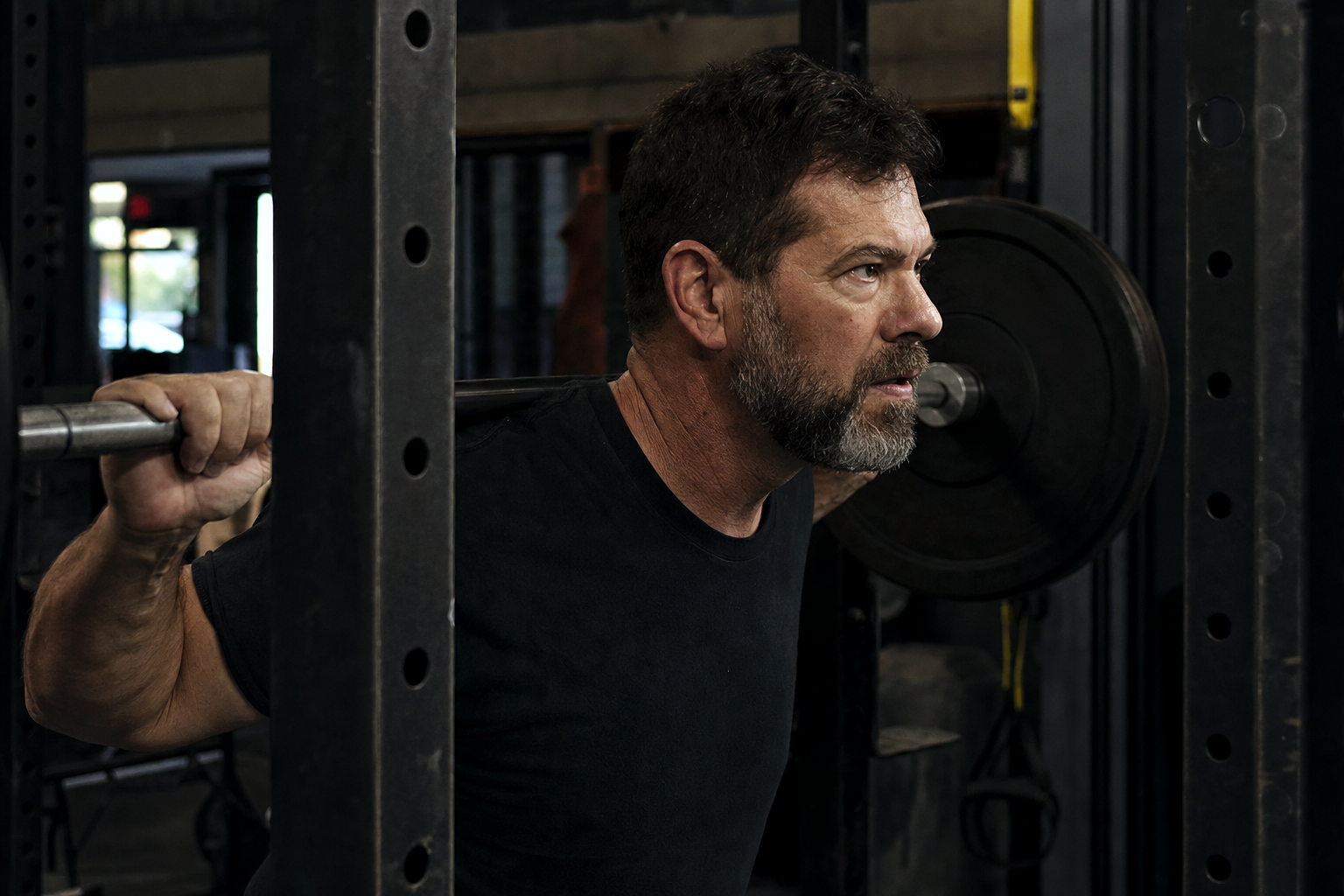
Your body still responds to stress the same way it did at 22. Apply load, recover, get stronger. The mechanism hasn't changed. What's changed is the recovery side of that equation.
Here's the basic process.
You walk into the gym and lift something heavy. Your muscle fibers sustain microscopic damage. Your nervous system gets an unfamiliar stimulus. Your body reads this as a threat and overcompensates — rebuilding the tissue slightly stronger than it was before. That's called supercompensation, and it's the entire basis of strength training.
At 40, testosterone is lower than it was at 20 — typically down 1-2% per year after 30. Growth hormone follows the same trend. This slows the repair process, not the adaptation itself. You still get stronger. It just takes 48-72 hours instead of 24.
The practical consequence: you can't train every day and expect progress. Three days a week, full-body compound movements, works better than six days of isolation work. Squats, deadlifts, presses, rows. These movements recruit the most muscle mass and drive the most systemic hormonal response.
Linear progression is your starting point. Add 5 pounds to the bar every session. It sounds too simple. It works anyway, because you're a novice — your nervous system alone can produce strength gains before your muscles even visibly change. You're not plateaued yet. Don't program like you are.
Nutrition runs parallel to training. You need enough protein — roughly 0.7 to 1 gram per pound of bodyweight — to provide the raw material for repair. Sleep is when the actual rebuilding happens. Cut either one short and you've wasted the session.
The process is mechanical. Follow it consistently and the results aren't optional.
Common Questions About Starting Strength Training at 40
Is it too late to build real muscle after 40? No. You'll build less muscle than a 22-year-old on the same program, but you'll still build meaningful muscle. Most people who ask this question have never trained seriously at any age. The bar is lower than you think.
How many days per week should I train? Three. Full-body, compound movements, every other day. Monday, Wednesday, Friday works. More isn't better — recovery takes longer now than it did at 25, and that's not a complaint, it's a fact to program around.
Will lifting heavy hurt my joints? Loaded movement done correctly protects joints. It strengthens the connective tissue, tendons, and surrounding musculature that hold everything together. Sitting at a desk for 20 years hurt your joints. Squatting with good technique fixes the damage.
Do I need a special program designed for older lifters? Not at first. A linear progression model like Starting Strength or StrongLifts works for most beginners regardless of age. You're not too old for beginner programming — you're just a beginner.
How long before I see results? Strength improves within two to three weeks. Visible body composition changes take eight to twelve weeks of consistent training and adequate protein. Anyone promising faster results is selling something.
What if I have old injuries? Train around them while you learn. A competent coach can modify movements. Most "bad knees" and "bad backs" respond well to properly loaded squats and deadlifts. Get assessed, not excused.
Conclusion
Starting strength training at 40 is not a consolation prize. It's a legitimate decision with serious physiological upside — more muscle, stronger bones, better insulin sensitivity, and a body that doesn't fall apart on you in your 60s.
Here's what matters: compound movements drive results. Squat, press, deadlift. Progressive overload is the mechanism. Recovery takes longer than it did at 22, so program accordingly. Ego is the most common source of injury at this age.
You don't need a complicated program. You need consistency, a barbell, and the willingness to add weight to it over time.
Three takeaways:
- Start simple. Linear progression works.
- Sleep and protein aren't optional recovery tools — they're the job.
- Soreness is fine. Pain is information. Learn the difference.
Pick a program. Start this week. The best time to begin was twenty years ago. The second best time is now.
Learn more about Strength Programming.